La Mancha
Don QuixoteLa Mancha is both the home ground of the unnamed gentleman who becomes Don Quixote of La Mancha and the name he deliberately takes into the world as part of his invented knightly identity. The region begins as a modest, unnamed village and becomes a name for a grand public vocation: the place from which he sets out to right wrongs, and to which he is eventually carried back in an ox-cart. Its significance lies less in a detailed geographical portrait than in the contrast between the ordinary life associated with it and the extravagant chivalric history its most famous inhabitant claims for it.
Home and Origins
The story opens in a village in La Mancha whose name the narrator declines to recall. Its gentleman is nearly fifty, spare and hardy, an early riser and keen sportsman. His household and finances are described through practical particulars: a housekeeper past forty, a niece under twenty, a working lad, a lean hack and a greyhound. Food consumes most of his income; the remainder goes toward better clothes for holidays, while on weekdays he wears homespun. These details establish a material, domestic point of departure for the adventures that follow. The region first appears not as a romantic landscape but as the setting of a recognisable household and a limited rural economy.
Even the gentleman’s surname is uncertain. The narrator reports competing possibilities, then says that reasonable conjecture points to Quexana, while treating the question as secondary to the tale. That uncertainty suits the story’s opening geography: the village is left unnamed, and its inhabitant’s identity is not fixed by ancestry alone. His eventual designation, Don Quixote of La Mancha, is something he actively makes.
A Region Made into a Knightly Identity
After reading romances of chivalry until he believes their inventions to be true, the gentleman decides that he must become a knight-errant. He imagines travelling the world in armour, correcting injustices and winning enduring fame. His transformation begins with the objects at hand: old armour recovered from a corner, a makeshift pasteboard helmet reinforced with iron, and his own lean horse, renamed Rocinante. The new knight’s regional identity is part of the same deliberate reconstruction. After settling on Don Quixote as his name, he adds La Mancha, following the example of Amadis of Gaul, whose name joined him to a kingdom and country. He believes the addition identifies his origin and honours it.
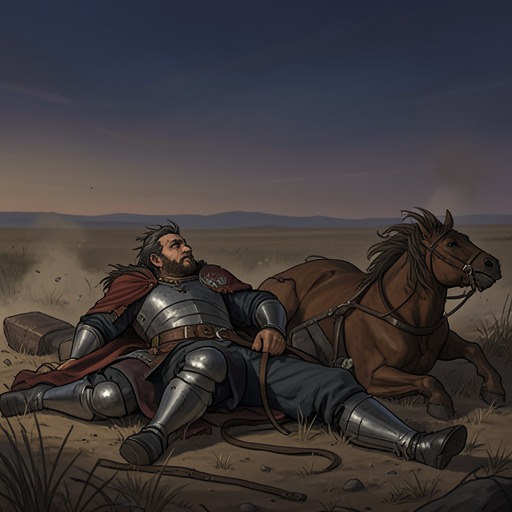
The name therefore carries two meanings at once. It locates him in the ordinary world from which he departs, but also makes that origin sound like the homeland of a figure in romance. His first departure tests the grandeur of the transformation against practical limits. Before dawn on a hot July morning, he leaves secretly by the yard’s back door, armed and mounted on Rocinante. Almost immediately he remembers that he has not been dubbed a knight and believes he must arrange for that ceremony. His imagined vocation is already governed by the rules he has absorbed from books, even as the village and its social reality remain close behind him.
As he rides across the Campo de Montiel, which the narrative says he is actually traversing, he imagines how a future sage will describe the dawn and his first sally. He pictures his deeds preserved in enduring forms and asks that the chronicler remember Rocinante, his constant companion. The passage makes the region a threshold between lived travel and self-authored legend: the road is real, but Don Quixote narrates it to himself as the opening scene of a history of fame. His sense that La Mancha can produce a hero is grander than the circumstances of his departure, and the mismatch supplies both comedy and momentum.
Roads, Encounters, and Regional Fame
The narrative’s roads give La Mancha a social dimension. Don Quixote introduces himself to travellers as a knight of La Mancha whose business is to roam the world righting wrongs. The declaration sets his ideal against the consequences of his interventions. After attacking mourners he has mistaken for something supernatural, he explains that his calling is to redress injuries; one of the men answers that the supposed redress has left him with a broken leg that will never recover. The region thus becomes the point of origin for a public identity whose claims are repeatedly tested by the people it affects.
Later, Don Quixote presents himself to a gentleman he meets on the road as a restorer of knight-errantry and a defender of widows, maidens, wives, orphans, and minors. He also claims that tens of thousands of volumes of his history have been printed and that the story is destined for vastly more. These are his own assertions, not a neutral account of La Mancha’s reputation, but they show how he turns his birthplace into a platform for imagined international renown. The gentleman in green is astonished not only by Don Quixote’s strange appearance but by his insistence that real knights-errant still travel the world.
The region’s name also frames encounters that are not simply solitary performances. On the way to the wedding of Quiteria and Camacho, Don Quixote joins two students and two peasants travelling together. The students understand his declaration that he is a knight-errant, while the peasants do not; the wedding is presented as one of the finest and richest celebrations held in La Mancha or the surrounding leagues. Its promised display and the couple’s unequal fortunes bring local social distinctions into the same narrative space as Don Quixote’s ideals. The journey’s company, rather than a battlefield or enchanted court, supplies the immediate setting for this meeting between chivalric expectation and ordinary life.
Return to the Village
The first part’s return makes the home village a communal place of recognition. After six days of travel in the ox-cart, Don Quixote arrives around midday on a Sunday, when people are gathered in the plaza. They recognise him as their townsman and crowd around the cart; a boy runs to tell the housekeeper and niece that he has come back thin and yellow, lying on a truss of hay. Their distress renews their denunciation of the books of chivalry they blame for his condition. Sancho Panza’s wife also comes to meet him, but her first concern is whether the donkey is well. The homecoming brings the imagined fame of knight-errantry down to the practical concerns of family, health, and property.
That return does not erase the identity Don Quixote has made from the region. Later, when defending his profession before the Duke and Duchess, he insists that he follows the narrow path of knight-errantry, despises wealth but not honour, and has acted with worthy intentions. He invokes La Mancha as his place of birth while describing himself as a knight who will remain one until death. The claim is at once a defence of his conduct and an assertion that his chosen vocation belongs to his identity as firmly as his origin does.
Narrative Significance
La Mancha’s narrative function rests on the friction between place and projection. The story supplies concrete local markers—a village, the Campo de Montiel, a plaza, roads shared with students and peasants, and a wedding celebrated as a regional spectacle—without turning the region into a sustained descriptive panorama. Instead, Don Quixote’s name makes it a chivalric homeland, and his conduct repeatedly exposes the gap between that self-image and the effects of his actions. He sets out to bring honour to his country, yet his first journey begins in secrecy and ends in injury and confinement; his return is met not with public acclaim but with alarm from those who know him.
The epitaph devoted to Don Quixote magnifies this tension by describing an arm renowned as far as Gaeta, Cathay, and the lands between, and a hero who surpassed the knights of romance. The poem’s scale is deliberately larger than the village life with which the book begins. La Mancha remains the anchor of that contrast: a real point of origin transformed, through its gentleman’s imagination and the story told about him, into the birthplace of a figure whose fame claims the world even as his travels repeatedly bring him back to local roads, local witnesses, and home.